artistic aproach
At the core of the Ellen Möckel’s practice lies an investigation into grids, systems of order, and the conditions of possibility that emerge within predefined structures. Rather than approaching the grid as a rigid apparatus of containment, Möckel understands it as a generative framework through which processes of deviation, displacement, and emancipation can take place. Rooted in the personal experience of not seamlessly inhabiting predetermined systems of classification and order, the practice explores the inherent ambivalence of such structures: while they provide orientation and establish frameworks of legibility, they simultaneously produce boundaries, exclusions, and forms of disorientation.
Her works examine these tensions across both analogue spatial environments and the visual regimes of the digital image. In this context, the grid functions not merely as a formal device, but as an analytical and conceptual instrument through which social, visual, and individual structures of order become perceptible and subject to negotiation. Of particular significance is the point at which a system begins to lose its presumed coherence and transparency, allowing something indeterminate, disruptive, autonomous, or potentially liberating to emerge from within its own logic.
Formally, the works oscillate between abstraction, fragmentation, and the construction of pictorial space. In doing so, they enter into a critical dialogue with diverse art-historical traditions, ranging from the Ukiyo-e tradition and Surrealism to Color Field painting. These references are not employed as stylistic quotations or direct appropriations; rather, they function as historical fields of resonance that situate the artist’s practice within a broader genealogy of questions concerning perception, spatial organization, orientation, and the conditions through which images produce meaning.
Ultimately, the works investigate the relationship between structure and agency: how much freedom can a system accommodate, and to what extent can structures intended to regulate perception and experience simultaneously generate possibilities for deviation and transformation? The artist’s practice thus locates freedom not necessarily outside systems of order, but potentially within their very boundaries—at the point where repetition gives way to difference, coherence to ambiguity, and structure to new forms of possibility.
academic degree „Meisterschülerin“
She completed her „Meisterschüler“ in Fine Arts at the Academy of Visual Arts in Leipzig in 2021, supervised by Prof. Michael Riedel.
more studies
Beside the „Meisterschüler“ degree, Ellen holds a diploma in Graphic Design and Book Arts from the Academy of Visual Arts Leipzig. Sie studied there from 2006-2013 under Prof. Markus Dressen, Oliver Kossack, Kathrin von Maltzahn & Thomas Müller. Earlier Ellen also studied Communication Design & Media at the University of Architecture and Design in Wismar from 2004-2005.
Guest at Niels Borch Jensens Workshop in Copenhagen
An 8 months stay at the workshop took place in Denmark, sponsored by an Erasmus+ grant from the Saxon State Ministry of Culture in 2011.
2nd prize, BiMA competition
In 2025, EM was awarded a prize for her entry in the public art category at Rostock University of Applied Sciences. Since then, alongside her freelance artistic work and her role at Suhrkamp Verlag – where Ellen has been responsible for book cover design since 2020 – she has undertaken further projects in this field.
Kickstarter Grant by Stiftung Kunstfonds
At the same time, she took on a number of smaller teaching assignments at Bremen University of Applied Sciences, the Academy of Fine Arts in Nuremberg, and the Evening School at the Academy of Visual Arts in Leipzig.
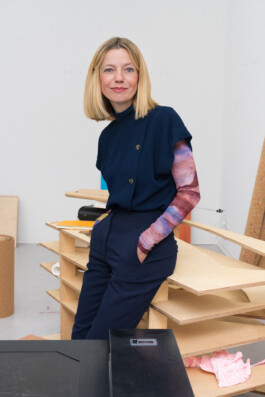
The artist lives and works in Berlin.
Ellen was born in Rostock, East Germany, in 1984.