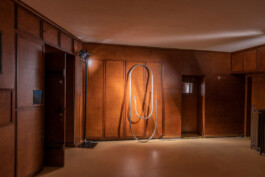
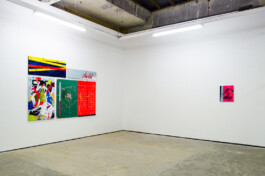
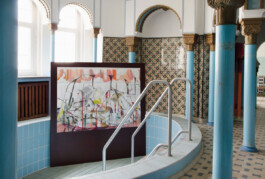
Das Cliffhanger Buch kommt in Kürze, die Seite ist aber aktuell noch im Aufbau...
Text: Buck up, Phoenix!
Starting from a series of 24 analogue drawings of a carousel swing ride, Ellen Möckel has developed a modular vocabulary of forms that serves as the foundation of an extensive body of work. Individual elements of these drawings are digitized and transferred onto various materials through laser engraving and printing processes. Rather than using these technologies merely to reproduce existing forms, Möckel treats the act of translation itself as a site of artistic inquiry, where forms are transformed through each stage of their transmission.
At the core of her practice are the processes of transformation that occur between analogue drawing, digital encoding, and material inscription. Much like a game of “telephone,” the original forms pass through multiple stages of translation, changing along the way. Machine settings, material properties, and technical inaccuracies all influence the outcome, producing shifts, deviations, and errors. It is precisely these moments of slippage and loss of control that reveal the agency of the process itself.
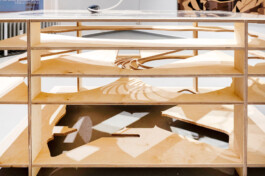
Möckel’s work explores the limits of machine precision as well as the limits of human control. Questions of technological fallibility, resolution, and temporality are intertwined with the persistent force through which the machine inscribes line after line into a surface. Materials such as wood and cork, which feature prominently throughout the series, become active participants in this process. Their irregular textures respond to technical intervention and shape the final result as profoundly as the artist’s own decisions.
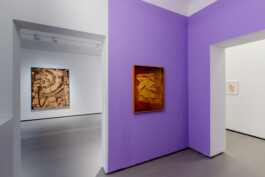
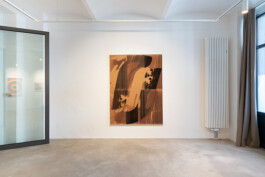
By deliberately probing these thresholds and points of resistance, Möckel creates a space in which intention and chance become inseparably linked. The resulting prints and installations are neither fully controlled compositions nor autonomous products of technology. Instead, they emerge through an ongoing dialogue between drawing, material, and machine. Each work can be understood as a record of this evolving exchange.
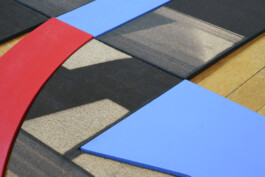
At the centre of the master’s exhibition was a tableau that made the fundamental principles of this practice visible. Conceived as a modular system, it allows for endless recombinations of individual forms and opens up a seemingly inexhaustible field of relationships. Repetition and variation, order and deviation, are negotiated here, alongside the question of how meaning shifts through even the slightest transformations.
The exhibition title refers to the Phoenix, the mythical bird that burns at the end of its life cycle only to rise again from its own ashes. As a symbol of recurrence, renewal, and transformation, the figure of the Phoenix has accompanied Möckel’s artistic practice throughout her years of study. The myth offers a poetic framework for understanding the processes underlying her work: forms return, are translated, altered, and reassembled. Like the Phoenix itself, they do not reappear as identical repetitions, but as continuous transformations of an existing visual repertoire.

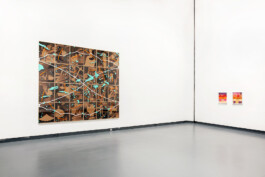
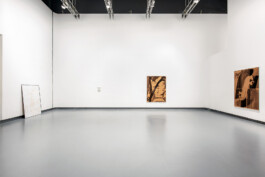
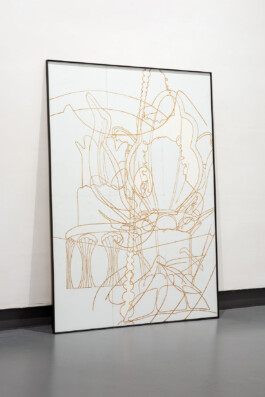
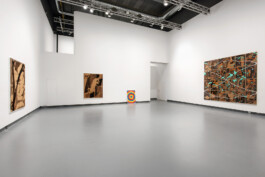


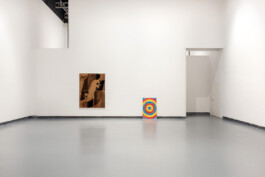
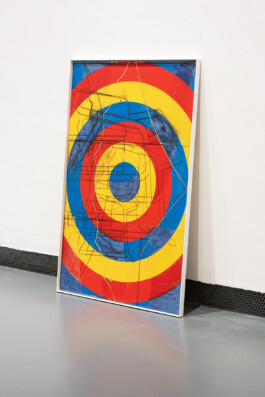

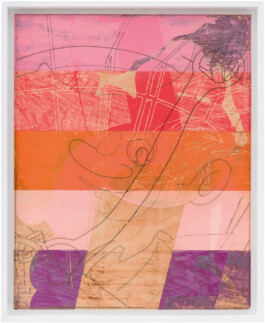
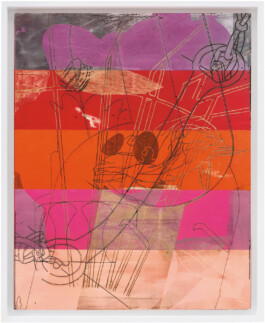

photo credit: © Sophia Kesting, 2021


Text: Buck up, Phoenix!
Starting from a series of 24 analogue drawings of a carousel swing ride, Ellen Möckel has developed a modular vocabulary of forms that serves as the foundation of an extensive body of work. Individual elements of these drawings are digitized and transferred onto various materials through laser engraving and printing processes. Rather than using these technologies merely to reproduce existing forms, Möckel treats the act of translation itself as a site of artistic inquiry, where forms are transformed through each stage of their transmission.
At the core of her practice are the processes of transformation that occur between analogue drawing, digital encoding, and material inscription. Much like a game of “telephone,” the original forms pass through multiple stages of translation, changing along the way. Machine settings, material properties, and technical inaccuracies all influence the outcome, producing shifts, deviations, and errors. It is precisely these moments of slippage and loss of control that reveal the agency of the process itself.
Möckel’s work explores the limits of machine precision as well as the limits of human control. Questions of technological fallibility, resolution, and temporality are intertwined with the persistent force through which the machine inscribes line after line into a surface. Materials such as wood and cork, which feature prominently throughout the series, become active participants in this process. Their irregular textures respond to technical intervention and shape the final result as profoundly as the artist’s own decisions.
By deliberately probing these thresholds and points of resistance, Möckel creates a space in which intention and chance become inseparably linked. The resulting prints and installations are neither fully controlled compositions nor autonomous products of technology. Instead, they emerge through an ongoing dialogue between drawing, material, and machine. Each work can be understood as a record of this evolving exchange.
At the centre of the master’s exhibition was a tableau that made the fundamental principles of this practice visible. Conceived as a modular system, it allows for endless recombinations of individual forms and opens up a seemingly inexhaustible field of relationships. Repetition and variation, order and deviation, are negotiated here, alongside the question of how meaning shifts through even the slightest transformations.
The exhibition title refers to the Phoenix, the mythical bird that burns at the end of its life cycle only to rise again from its own ashes. As a symbol of recurrence, renewal, and transformation, the figure of the Phoenix has accompanied Möckel’s artistic practice throughout her years of study. The myth offers a poetic framework for understanding the processes underlying her work: forms return, are translated, altered, and reassembled. Like the Phoenix itself, they do not reappear as identical repetitions, but as continuous transformations of an existing visual repertoire.
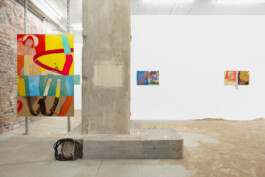
photo credit: © Sophia Kesting, 2021