artistic aproach
At the center of my artistic practice is an interest in how meaning is created, transformed, and shifted through context. My work begins with a personal image archive, which I organize according to the original meanings and designations of the images I collect. The archive functions as a personal system of order: it preserves images within their original contexts while also revealing how closely meaning is tied to naming, classification, and context.
I take individual forms and fragments from this archive, deconstruct them, and recombine them to create new images. Through this process, the original meaning of a form remains perceptible, but gradually becomes less important as it enters a new context. The forms retain traces of what they once represented, while their new surroundings allow them to take on different relationships and meanings. Meaning is not erased, but displaced. I am interested in this space between recognition and estrangement—the moment when something feels familiar but can no longer be clearly identified or assigned. A fragment can lose its original function and assume a different role within a new pictorial space. Existing structures thus become the starting point for new relationships, readings, and possibilities.
The grid and other forms of order are important tools within this process. They provide orientation and establish a framework, but they are never completely closed. Through repetition, fragmentation, displacement, and recombination, deviations can emerge from within the structure itself. The system remains visible, but its function begins to shift. This interest is also connected to my personal experience of not always fitting seamlessly into predetermined systems and categories. Structures can create orientation and a sense of belonging, but they can also establish boundaries and produce exclusion. I am therefore interested in how spaces for agency can emerge within existing structures—not necessarily by escaping the system, but by changing the relationships within it.
Formally, my work moves between abstraction, fragmentation, and the construction of pictorial space. It enters into dialogue with different art-historical traditions, including Ukiyo-e, Surrealism, and Color Field painting. I approach these references not as direct quotations, but as fields of resonance through which I explore perception, visual organization, spatial orientation, and the ways in which images produce meaning.
Ultimately, I am interested in what happens when an existing order is not abandoned, but transformed. My work attempts to capture the moment in which an original meaning is still present, yet loses its certainty through a new context. Something familiar becomes something new—not because its origin disappears, but because it enters into a different relationship with everything around it.
prices and stipends
In 2025, EM was awarded a prize from a BiMA competition for her entry in the public art category at Rostock University of Applied Sciences. In 2020, Ellen received the Kickstarter Grant from the Stiftung Kunstfonds. Earlier in 2018, she received a DAAD scholarship for a six-month stay in London and and in 2014 she received the Kunsthütte Chemnitz Prize as part of the 100 selected graphic works from Saxony.
academic degree „Meisterschülerin“
She completed her „Meisterschüler“ in Fine Arts at the Academy of Visual Arts in Leipzig in 2021, supervised by Prof. Michael Riedel.
more studies
Beside the „Meisterschüler“ degree, Ellen holds a diploma in Graphic Design and Book Arts from the Academy of Visual Arts Leipzig. Sie studied there from 2006-2013 under Prof. Markus Dressen, Oliver Kossack, Kathrin von Maltzahn & Thomas Müller. Earlier Ellen also studied Communication Design & Media at the University of Architecture and Design in Wismar from 2004-2005.
guest at Niels Borch Jensens Workshop in Copenhagen
An 8 months stay at the workshop took place in Denmark, sponsored by an Erasmus+ grant from the Saxon State Ministry of Culture in 2011.
work experiences
Alongside her freelance artistic work and her role at Suhrkamp Verlag – where Ellen has been responsible for book cover design since 2020 – she took on a number of smaller teaching assignments at Bremen University of Applied Sciences, the Academy of Fine Arts in Nuremberg, and the Evening School at the Academy of Visual Arts in Leipzig.
The artist lives and works in Berlin.
Ellen was born in Rostock, East Germany, in 1984.
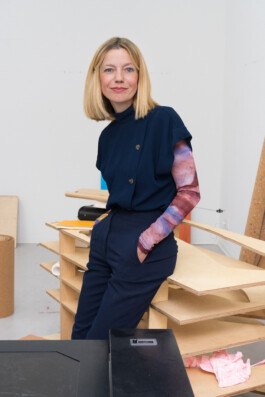
photo: © Hans Panichen, Berlin 2026
artistic aproach
At the center of my artistic practice is an interest in how meaning is created, transformed, and shifted through context. My work begins with a personal image archive, which I organize according to the original meanings and designations of the images I collect. The archive functions as a personal system of order: it preserves images within their original contexts while also revealing how closely meaning is tied to naming, classification, and context.
I take individual forms and fragments from this archive, deconstruct them, and recombine them to create new images. Through this process, the original meaning of a form remains perceptible, but gradually becomes less important as it enters a new context. The forms retain traces of what they once represented, while their new surroundings allow them to take on different relationships and meanings. Meaning is not erased, but displaced. I am interested in this space between recognition and estrangement—the moment when something feels familiar but can no longer be clearly identified or assigned. A fragment can lose its original function and assume a different role within a new pictorial space. Existing structures thus become the starting point for new relationships, readings, and possibilities.
The grid and other forms of order are important tools within this process. They provide orientation and establish a framework, but they are never completely closed. Through repetition, fragmentation, displacement, and recombination, deviations can emerge from within the structure itself. The system remains visible, but its function begins to shift. This interest is also connected to my personal experience of not always fitting seamlessly into predetermined systems and categories. Structures can create orientation and a sense of belonging, but they can also establish boundaries and produce exclusion. I am therefore interested in how spaces for agency can emerge within existing structures—not necessarily by escaping the system, but by changing the relationships within it.
Formally, my work moves between abstraction, fragmentation, and the construction of pictorial space. It enters into dialogue with different art-historical traditions, including Ukiyo-e, Surrealism, and Color Field painting. I approach these references not as direct quotations, but as fields of resonance through which I explore perception, visual organization, spatial orientation, and the ways in which images produce meaning.
Ultimately, I am interested in what happens when an existing order is not abandoned, but transformed. My work attempts to capture the moment in which an original meaning is still present, yet loses its certainty through a new context. Something familiar becomes something new—not because its origin disappears, but because it enters into a different relationship with everything around it.
prices and stipends
In 2025, EM was awarded a prize from a BiMA competition for her entry in the public art category at Rostock University of Applied Sciences. In 2020, Ellen received the Kickstarter Grant from the Stiftung Kunstfonds. Earlier in 2018, she received a DAAD scholarship for a six-month stay in London and and in 2014 she received the Kunsthütte Chemnitz Prize as part of the 100 selected graphic works from Saxony.
academic degree „Meisterschülerin“
She completed her „Meisterschüler“ in Fine Arts at the Academy of Visual Arts in Leipzig in 2021, supervised by Prof. Michael Riedel.
more studies
Beside the „Meisterschüler“ degree, Ellen holds a diploma in Graphic Design and Book Arts from the Academy of Visual Arts Leipzig. Sie studied there from 2006-2013 under Prof. Markus Dressen, Oliver Kossack, Kathrin von Maltzahn & Thomas Müller. Earlier Ellen also studied Communication Design & Media at the University of Architecture and Design in Wismar from 2004-2005.
guest at Niels Borch Jensens Workshop in Copenhagen
An 8 months stay at the workshop took place in Denmark, sponsored by an Erasmus+ grant from the Saxon State Ministry of Culture in 2011.
work experiences
Alongside her freelance artistic work and her role at Suhrkamp Verlag – where Ellen has been responsible for book cover design since 2020 – she took on a number of smaller teaching assignments at Bremen University of Applied Sciences, the Academy of Fine Arts in Nuremberg, and the Evening School at the Academy of Visual Arts in Leipzig.
The artist lives and works in Berlin.
Ellen was born in Rostock, East Germany, in 1984.

photo: © Hans Panichen, Berlin 2026